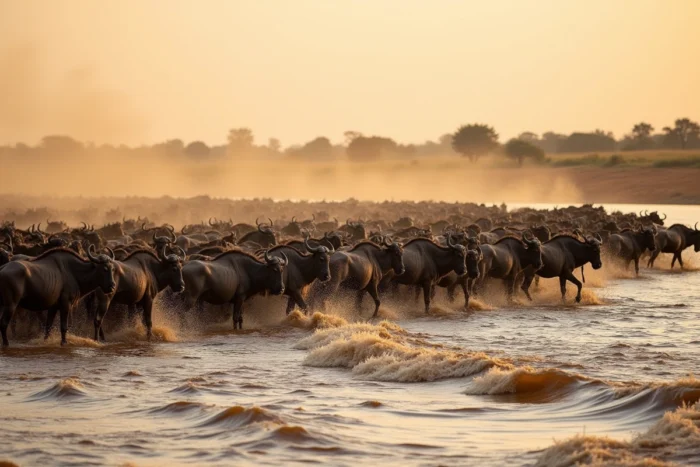
Animal migration is not just a seasonal movement between two fixed points. Recent work on the actual trajectories of species shows that predictive movement models underestimate individual variability in routes, complicating the planning of protected areas and ecological corridors.
Errors in Predictive Models and Migration Corridors
The climate models used to anticipate species movements rely on projections of temperature and vegetation. They assume that animals will follow favorable conditions as they shift geographically. In practice, the direction and speed of species movement do not always align with these projections.
Mongabay reports that unpredictable wildlife movements make planning for climate change particularly challenging. Some species remain trapped in fragmented habitats instead of migrating to theoretically more favorable areas. A corridor modeled as viable can become an ecological trap if the intermediate habitat is fragmented by infrastructure or intensive agriculture.
An operational paradox emerges: protecting a migration corridor assumes knowledge of where animals will go, but field data regularly contradict forecasts. For a comprehensive report on animal migration on La Maison des Animaux, the fundamental mechanisms are detailed species by species.
The answer to this gap between model and reality involves real-time tracking networks (GPS tags, ornithological radars) coupled with sufficiently wide buffer zones to absorb trajectory deviations.

Habitat Fragmentation and Blocked Migration in Terrestrial Species
Fragmentation is the most underestimated limiting factor in discussions about migration. An animal capable of traveling thousands of kilometers by flight or swimming does not face the same obstacles as a terrestrial mammal confronted with a highway, a farm fence, or an urban area.
Some species are unable to migrate at all because their habitats are fragmented by human activities. This observation invalidates the idea of automatically adaptive migration. The animal does not “choose” to stay: it is physically prevented from moving.
African ungulates illustrate this constraint. Serengeti wildebeests still benefit from relatively continuous space, but in other regions of Africa, agricultural expansion has fragmented the migratory routes of several populations of antelopes, reducing their ability to move according to the seasons.
Concrete Measures Against Fragmentation
- Wildlife crossings (ecoducts, underpasses) must be positioned based on real tracking data, not just on potential habitat models
- Peripheral buffer zones around protected areas absorb interannual variations in migratory trajectory
- Connectivity between nature reserves takes precedence over the individual size of each reserve: a network of well-connected small areas protects better than a large isolated park
Migratory Birds and Energy Expenditure in Flight
Migratory flight imposes a colossal energy constraint. Migratory birds accumulate lipid reserves before departure, and managing this energy determines their survival as much as the route chosen. Species that cross non-stop areas (sea, desert) operate without margin for error.
The loss of a single migratory stopover site can jeopardize an entire population. Geese and shorebirds that transit through the wetlands of northern Africa depend on specific marshes to replenish their reserves. The drying up of a wetland cannot be easily compensated by relocating to another site, as the additional distance often exceeds the bird’s residual energy capacity.

In certain migration corridors between Africa and Europe, migratory raptors face direct pressure from poaching. The combination of a direct threat (shooting) and an indirect threat (loss of stopovers) creates a cumulative effect that risk assessments rarely address together.
Radar Tracking and GPS Tags
Tracking technologies have transformed the understanding of avian migratory routes. Ornithological radars detect nocturnal flows invisible to direct observation. Miniaturized GPS tags allow tracking of an individual over multiple annual cycles and measuring route deviations from year to year.
These data reveal that migratory routes vary more between individuals of the same species than traditional maps suggest. This individual variability has direct implications for conservation: protecting an “average” corridor is not sufficient if a significant fraction of the population takes peripheral routes.
Threatened Migratory Species in Canada and Regulatory Framework
Canada hosts many migratory species, from birds to fish to bats and insects whose movements remain poorly understood.
- Pacific salmon depend on unobstructed waterways to spawn, and each dam or diversion reduces reproductive success rates
- Migratory bats suffer high mortality near wind turbines, a direct conflict between energy transition and conservation
- Monarch butterflies, whose migration covers thousands of kilometers southward, see their breeding and wintering habitats shrinking simultaneously
Canadian regulations on migratory birds are regularly updated, with a series of consultation reports published by Environment and Climate Change Canada. These legal frameworks set hunting seasons, quotas, and protection zones, but their effectiveness depends on the quality of available population data.
Protecting migratory species faces a jurisdictional issue: an animal crossing multiple countries cannot be protected by a single national framework. International conventions exist, but their enforcement remains uneven from country to country. As long as tracking data is not shared in real-time across jurisdictions, migratory corridors will remain patchily protected, with gaps in the net exactly where animals are most vulnerable.