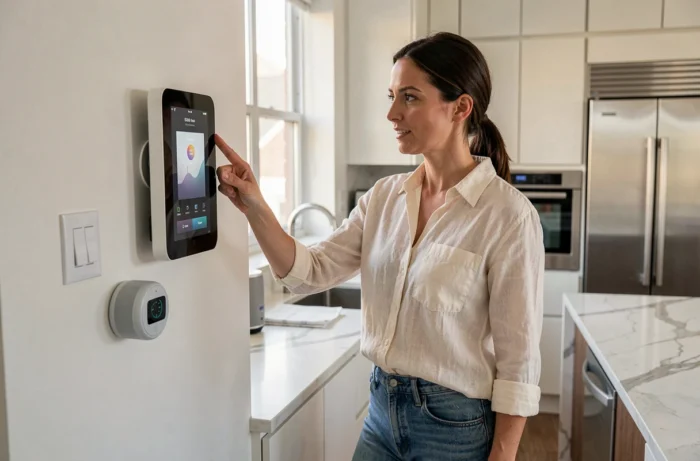
A connected home object is a physical device (thermostat, bulb, opening sensor, camera) linked to a local network or the Internet, capable of sending and receiving data to perform actions without manual intervention. The smart home refers to the collection formed by these connected objects when they communicate with each other via a home automation hub or a centralized application.
Communication Protocols: What Really Determines Compatibility
Before choosing any equipment, the question to settle concerns the communication protocol used. Wi-Fi, Bluetooth, Zigbee, Z-Wave, Thread: each radio technology imposes its constraints on range, power consumption, and the maximum number of devices on the network.
Zigbee and Z-Wave operate on a mesh network, where each device relays the signal from its neighbors. A door sensor placed far from the hub remains reachable if other modules are located between the two. Wi-Fi, on the other hand, offers higher throughput but puts more strain on the batteries of standalone sensors.
The Matter standard, intended to unify the ecosystem, deserves caution. Recent industry feedback indicates shortcomings in actual implementation: some Matter-certified devices do not yet manage all categories of peripherals, and the compatibility advertised on the packaging does not guarantee smooth integration with all hubs on the market. Checking the exact list of Matter functions supported by each device remains a useful reflex before purchase.
Detailed technical sheets on the main protocols and equipment can be consulted on objets-domotique.fr, which helps compare specifications before diving in.
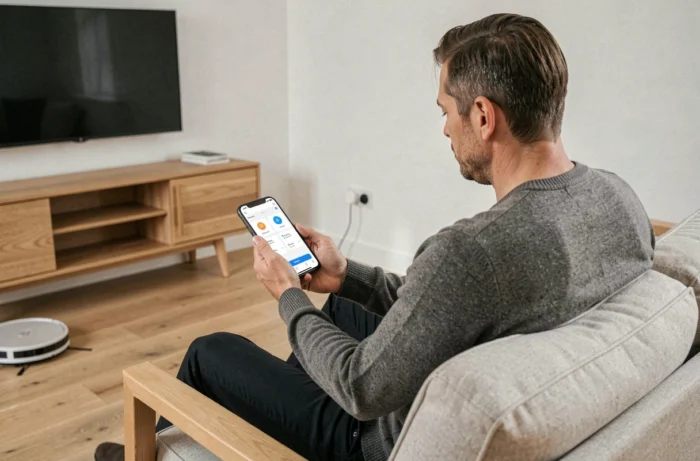
Cybersecurity of Connected Objects: European Obligations to Know
Most buying guides compare features and prices. They overlook a criterion that has become regulatory: the duration of software support and security patches.
Since August 1, 2025, the European RED directive imposes cybersecurity requirements on connected radio equipment (Wi-Fi, Bluetooth, Zigbee, 4G). The harmonized standards EN 18031, published in the Official Journal of the European Union on January 30, 2025, cover resistance to network attacks and the protection of personal data.
The Cyber Resilience Act Further Strengthens the Framework
Since September 11, 2026, the Cyber Resilience Act (CRA) requires manufacturers to report any actively exploited vulnerability within 24 hours, and then to provide a complete notification within 72 hours. The European Commission specifies that these rules also apply to products already marketed in the European Union.
In practice, this means that a connected thermostat or a surveillance camera sold in France must receive security updates for as long as it is on the market. A manufacturer that ceases software support for a product still on sale violates the regulation.
- Before purchasing, check if the manufacturer publishes a software support policy with a minimum announced duration.
- Prefer brands that specify the update frequency and the expected end of support date.
- Exclude devices whose firmware has not been updated for more than a year, a sign of likely abandonment.
Choosing a Home Automation Hub or Voice Assistant as a Central Hub
The central hub is the brain of the system. Two approaches coexist: the dedicated home automation hub (Jeedom, Home Assistant, Homey) and the consumer voice assistant (Amazon Echo, Google Nest).
The home automation hub offers finer control over automation scenarios. It allows for cross-referencing data from multiple sensors (temperature, brightness, presence) to trigger chained actions, such as lowering the heating and closing the shutters when no one is detected for thirty minutes.
The voice assistant simplifies installation and daily voice control. However, complex automations remain limited, and reliance on the manufacturer’s cloud poses issues of latency and continuity in case of Internet outages.
A Often Overlooked Criterion: Local Compatibility
A hub that executes scenarios locally (without going through a remote server) ensures operation even if the Internet connection drops. This is a point to check in the technical sheet, as some hubs switch to the cloud without clearly indicating it.
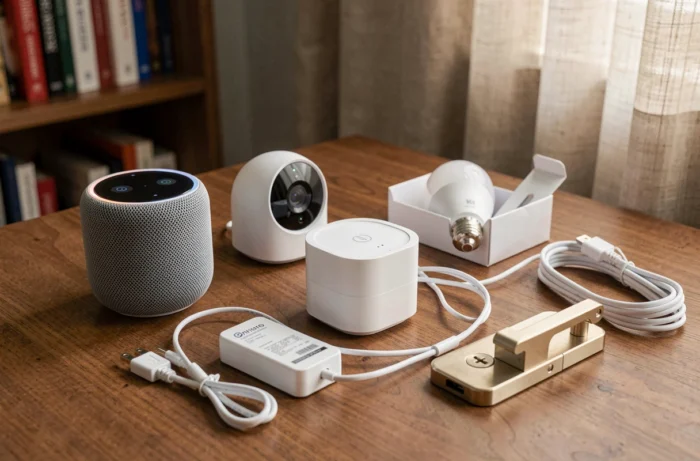
Lighting, Heating, Security: Which Room to Start With
A common mistake is to equip the entire house at once. It is better to start with a specific use that produces measurable benefits.
The connected thermostat is often the first profitable investment. By adjusting heating according to the actual presence of occupants, it reduces consumption effortlessly. All it takes is a thermostat, a presence sensor, and a Wi-Fi connection to achieve a first functional scenario.
Connected lighting (bulbs, LED strips) represents a second accessible level. Remote control from a smartphone allows simulating presence during prolonged absence, a use that combines comfort and security.
- Garage and gate: a remote control module allows opening or closing without retracing steps, useful for deliveries.
- Garden: a connected irrigation timer adjusts cycles according to local weather, avoiding water waste.
- Security: an outdoor camera coupled with a motion detector sends targeted alerts, more reliable than older single-trigger systems.
The guiding principle remains the same: each added device must solve a concrete problem or automate a repetitive task. A connected object that only serves to consult a statistic on a screen often ends up unplugged after a few weeks.