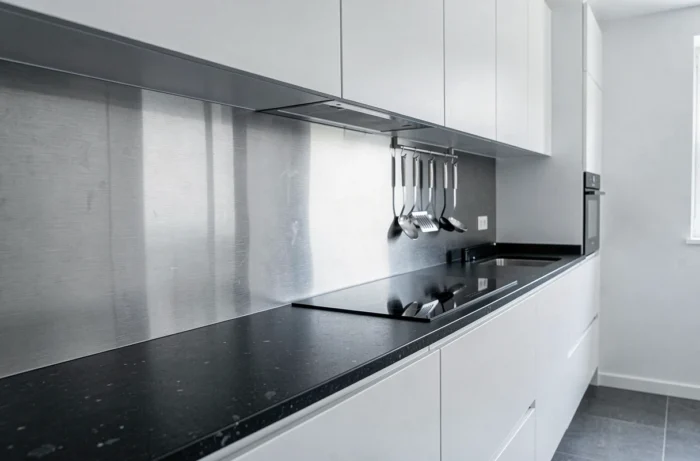
When replacing an old tiled backsplash with a stainless steel panel, the first instinct is to measure the space between the countertop and the upper cabinets. And that’s where things get complicated: electrical outlets to cut out, walls that aren’t square, side returns to plan for. Custom stainless steel responds to these job site constraints much better than a standard panel that you adjust with a cutter.
Installation constraints of a stainless steel backsplash: what changes with custom
On a perfectly straight wall, a standard backsplash may suffice. The problem is that most kitchen walls are not perfectly straight. A gap of a few millimeters in the flatness of the support is immediately visible on a stainless steel surface because the metal reflects light and reveals the slightest waviness.
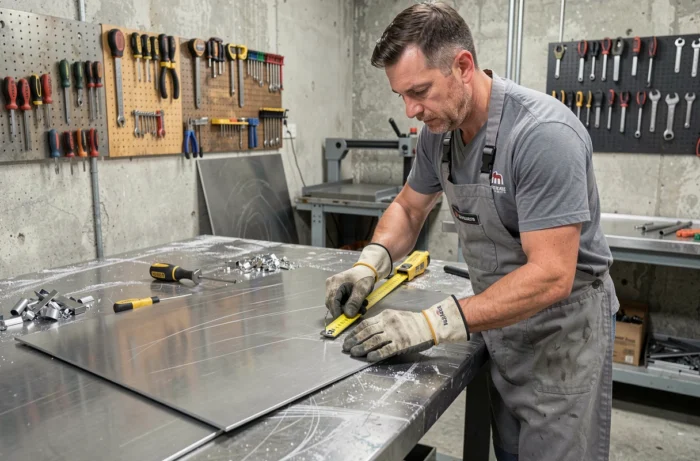
Choosing a custom stainless steel backsplash for the kitchen allows for the panel to be manufactured to exact dimensions, with cutouts already planned for outlets, switches, and gas connections. This avoids on-site DIY work, which often leaves irregular edges or unsightly joints.
Returns vary depending on configurations. An L-shaped return on an inward corner requires precise bending, sometimes welded in the workshop. An outward corner requires a rounded edge or a butt joint where the connection remains almost invisible. The angles and cutouts determine the final quality, much more than the choice of finish.
- Check the flatness of the wall with a mason’s rule before ordering: a defect of more than a few millimeters requires leveling or compensating shims.
- Identify all cutouts (outlets, switches, pipes) and provide a dimensioned plan to the manufacturer, ideally with photos.
- Plan the installation direction if the backsplash is several meters long: a panel delivered in one piece is cleaner but more difficult to handle in a narrow staircase.
Brushed or mirror stainless steel backsplash: choose according to actual use
The mirror finish catches the eye in a showroom. In real situations, behind a cooking panel, it reveals every fingerprint, every grease splash, and every drop of hard water. You spend more time wiping than cooking.
The brushed finish reduces marks and micro-scratches in everyday use. It maintains the professional aesthetic of stainless steel while tolerating the patina that develops over the years. Feedback on this point converges: for intensive use, brushed remains the most pragmatic choice.
Other textures exist (vibrated stainless steel, linen cloth, dimpled) and provide a more pronounced grain. They work well on small surfaces, like a hood background, but can visually overload a large backsplash of several square meters. The choice of material and its texture thus depends as much on the covered surface as on the desired style.
Thickness of the panel: a parameter often overlooked
We are rarely asked what thickness to choose, yet it is a criterion that influences rigidity, sound rendering (a thin panel vibrates when touched), and ease of installation. A sufficient thickness avoids the “tin” effect to the touch and ensures better durability over time, especially on long spans without intermediate support.
Stainless steel and proximity to heat sources: a concrete technical advantage
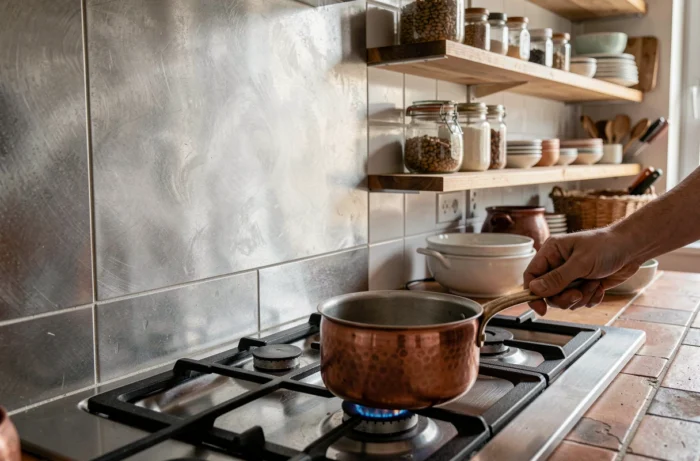
Behind a gas panel, the backsplash endures repeated temperature rises. Tempered glass withstands heat, but some laminates or composite panels impose more stringent safety distances according to the manufacturers’ instructions for cooking panels.
Stainless steel remains the most suitable material for direct contact with a heat source. It does not deform, does not yellow, and does not release any substances under the effect of temperature. This is why professional kitchens have used it for decades, long before it became a decorative choice.
For configurations with a wide cooking range, a custom stainless steel backsplash covers the entire area without joints. You get a continuous surface, easy to clean in one motion, without joints where grease accumulates.
Combining the stainless steel backsplash with other kitchen materials
Stainless steel works by contrast. Placed against a raw wood wall or next to a stone countertop, it creates a visual tension that structures the space. Paired with white lacquered fronts, it extends the vocabulary of contemporary design without weighing it down.
Some combinations that work well in modern kitchens:
- Solid wood countertop (oak, beech) with brushed stainless steel backsplash: wood warms, stainless steel brings clarity.
- Dark matte fronts (anthracite, midnight blue) with mirror stainless steel backsplash only at the hood: the luminous effect remains punctual and controlled.
- Light quartz countertop with stainless steel backsplash along the entire length: coherence between smooth surfaces, simplified maintenance.
- Central island clad in stainless steel in continuity with the backsplash: unifies the design and facilitates cleaning of preparation areas.
A common mistake is to multiply materials in a small space. Limiting the palette to two or three materials maximum yields a more coherent result than a patchwork of textures.
Colors and reflections: consider natural light
A stainless steel backsplash facing a window will capture and redistribute light throughout the room. In a south-facing open kitchen, this effect can become dazzling in the middle of the day. The brushed finish limits this phenomenon by diffusing light rather than reflecting it directly.
In a dark or elongated kitchen, the mirror stainless steel placed at the hood background acts as a small brightness amplifier, without needing additional lighting. The choice of finish thus also depends on the configuration of the space, not just personal taste.
A custom stainless steel backsplash is not just a wall covering. It is a technical piece, manufactured to the exact dimensions of your kitchen, that solves installation problems, withstands heat without flinching, and integrates durably into the design of the room. The real criterion for choice remains the quality of the measurements and the precision of the manufacturing, well before the question of brushed or mirror.