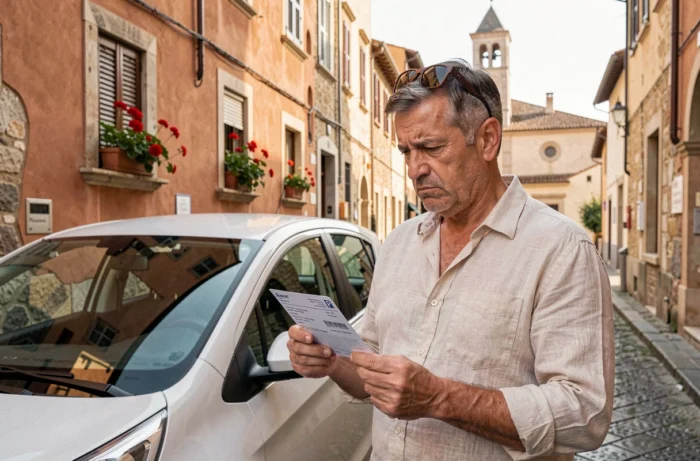
A letter arrives several months after a stay in Italy, demanding payment of a fine for driving in a restricted area. The amount seems plausible, the document mentions a city crossed, and the date matches. The difficulty lies in a specific point: the Italian administration has up to 360 days after identifying the owner to notify a foreign driver of an infraction. A real ticket can therefore arrive very late, which blurs the line between legitimate correspondence and an attempt at fraud.
Notification period and duration of prosecution: the data that changes the analysis
Most French drivers consider that a letter received six months or a year after their trip is necessarily suspicious. Article 201 of the Codice della Strada states otherwise.
| Criterion | Real Italian ticket (foreign driver) | Typical fraudulent letter |
|---|---|---|
| Possible reception period | Up to 360 days after identification | Variable, often 3 to 8 months |
| Sender | Polizia Municipale or Italian municipality | Private collection agency (e.g., NIVI S.p.A.) |
| Mode of sending | Registered mail with acknowledgment of receipt | Standard mail, sometimes not registered |
| Legal references | Ticket number, article of the Codice della Strada | Vague or absent references |
| Requested payment method | Bank transfer to municipal treasury | Online link, transfer to private account |
This table highlights a often overlooked point: the time frame alone does not allow distinguishing a real ticket from a fake one. The sender and the mode of sending are much more reliable indicators than the reception date.
An article detailing the scam of a false fine in Italy according to CarburAuto precisely describes the legal circuit of the Italian fine and the warning signals to check on each letter received.

Private collection agency and Italian fine: why confusion persists
Private collection agencies like NIVI S.p.A. sometimes intervene on behalf of Italian municipalities. Their legal role is limited to transmitting a payment notice, not issuing the ticket itself.
The problem is that these agencies send letters whose layout mimics that of an official document. The amounts requested (often around 250 euros) correspond to realistic ranges for a ZTL infraction. A driver who has indeed driven in a restricted area has no immediate reason to doubt.
What these agencies can and cannot do
A civil collection agency has no enforcement power in France. It cannot seize a bank account or register a debt in the payment incident file. If the letter does not come directly from the Italian criminal authorities, no enforcement procedure is possible on French territory.
Several testimonies on French legal forums describe the same pattern: a first standard letter, then a second labeled as “second administrative notification,” with a slightly increased amount. This escalation aims to create a sense of urgency without real legal basis.
- A non-registered letter from a private company does not constitute a legal notification under Italian law
- The absence of a ticket number (Italian verbale) on the document is a major warning signal
- A real ticket systematically mentions the issuing municipality, the number of the issuing officer, and the article of the code violated
- The requested payment to a private bank account (and not a municipal treasury) indicates an unofficial process
Reform of the Italian highway code and foreign plates: what is being prepared
Italy is preparing a notable tightening of the prosecution of unpaid fines for vehicles registered abroad. The project stipulates that a driver may be asked to pay an unpaid fine for up to five years during a new check in Italy with the same vehicle.
Until now, cross-border administrative complexity often caused these procedures to fall through. This change alters the calculation for two categories of people: those who ignore a real ticket thinking it will never be enforced, and those who receive a fake letter exploiting this reform to appear credible.
Concrete impact for French drivers
A driver who regularly returns to Italy (cross-border commuters, frequent travelers) now has an interest in verifying the legitimacy of each letter received rather than ignoring it. Ignoring a real ticket exposes one to a claim during a future visit to Italy.
On the other hand, this reform does not change the power of private collection agencies on French soil. The distinction remains the same: only a procedure originating from the Italian authorities (municipal police, prefecture) can have legal consequences.
Check an Italian ticket received in France: the decisive checkpoints
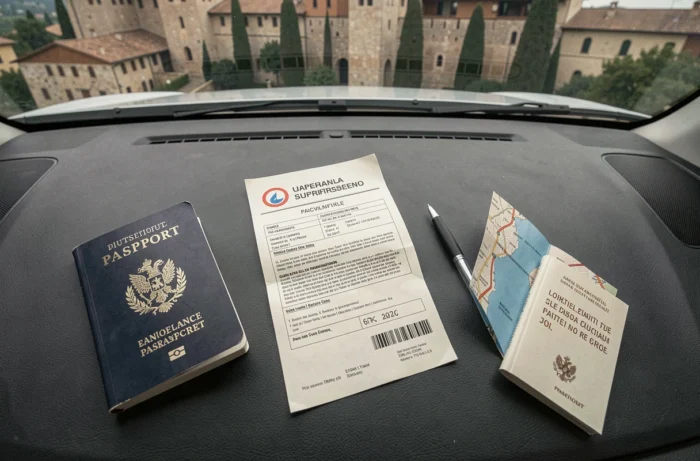
Rather than a list of generic advice, three checks allow for a quick decision.
The first concerns the sender. A real Italian ticket bears the name and stamp of the Polizia Municipale or the municipality where the infraction was committed. If the letter comes exclusively from a private company without mention of the issuing authority, caution is warranted.
The second concerns the ticket number. This number, unique to each Italian ticket, can be verified with the relevant municipality. Its absence on the document is the most reliable signal of an unofficial letter.
The third concerns the rental vehicle. When the infraction was committed with a rented vehicle, the rental company first receives the ticket and then forwards the driver’s details to the Italian municipality. This transfer further extends the reception period. A letter that arrives directly to the driver without going through the rental company, for an infraction committed in a rental vehicle, deserves thorough verification.
The five-year prosecution period envisaged by the Italian reform makes these checks even more relevant. A legitimate ticket ignored today could resurface during a future trip, while a fake letter paid by mistake will never be refunded.