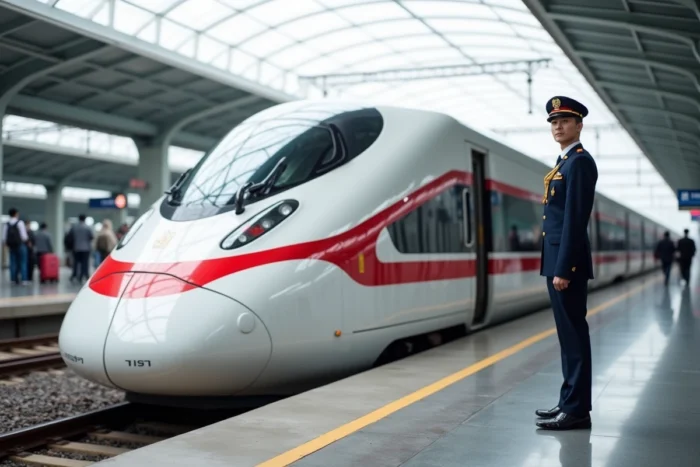
A train traveling at 603 km/h does not roll. It floats, lifted by magnets, with no contact with the track. This record belongs to the Japanese SCMaglev, established in 2015 on a test line in Yamanashi Prefecture. To understand why this figure tells only part of the story, it is necessary to distinguish between technical record and actual speed in commercial service.
Magnetic levitation: the principle that makes speed possible
Have you ever brought two magnets of the same pole together? They repel each other. The Maglev train exploits exactly this force. The word itself combines “magnetic” and “levitation”.
Specifically, superconducting electromagnets are installed under the train. The guiding track contains coils. When current flows, magnetic repulsion lifts the train a few centimeters above the rail. No more mechanical friction, no more wheels slowing down the journey.
This absence of physical contact changes everything. A conventional train loses a significant portion of its energy overcoming the friction between wheel and rail. The Maglev eliminates this drag. Its only resistance remains air, which explains the streamlined, almost aeronautical shape of the train.
Knowing which train is the fastest in the world requires understanding this technological breakthrough. The speed of the SCMaglev is not just a simple incremental improvement; it is a paradigm shift compared to conventional rail.

Test record at 603 km/h and expected commercial speed of the SCMaglev
The figure of 603 km/h was achieved under test conditions, on a dedicated stretch in the Yamanashi valley. No passengers on board that day, no daily operational constraints. The distinction matters.
The future commercial line, named Chuo Shinkansen, aims to connect Tokyo to Nagoya. The planned operating speed is around 500 km/h. The gap of over 100 km/h between the record and actual service is explained by safety margins, wear of components, and passenger comfort.
This is a common pattern in railways. The French TGV holds a record on conventional rail well above its service speed. Records serve to validate technology, not to define daily operations.
Why the Chuo Shinkansen is delayed
The Tokyo-Nagoya line project was initially set to open earlier, but it has faced multiple delays. Several factors are at play:
- The construction cost is colossal, estimated at several billion euros, fueling a national debate on the relevance of the investment compared to other priorities.
- Local opposition has emerged, particularly regarding the environmental impacts of tunneling in the Japanese Alps and the consequences for groundwater resources.
- The technical complexity of a superconducting network over long distances remains an engineering challenge without true precedent at this scale.
The Japanese Maglev is as much a technological showcase as it is a controversial project in the archipelago. The speed feat does not suffice to reach consensus when costs and territorial impacts come into play.
China, France, Korea: where fast trains are in service today
The Japanese SCMaglev does not yet transport passengers daily. So, which fast train can we actually take today?
In Shanghai, a magnetic levitation Transrapid connects Pudong Airport to downtown. It is the only Maglev in regular commercial service in the world. Its operating speed is significantly lower than the Japanese record, but the experience of gliding above the rail has indeed existed in China since the early 2000s.
On conventional rail, China dominates with its high-speed network, the largest in the world. The Fuxing trains reach some of the highest commercial speeds in the global rail network. The network connects metropolises separated by considerable distances, making trains competitive with planes on many domestic routes.
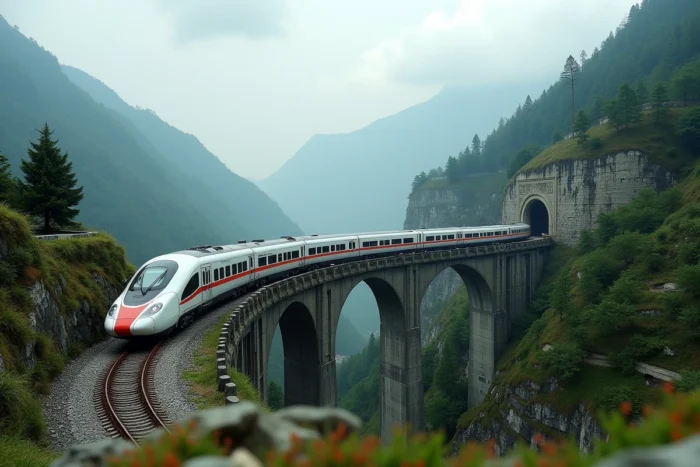
In France, the TGV remains a historical reference. Its record on conventional rail, set several years ago, marked railway history. The commercial speed of the TGV is much more modest, but the network serves the country from Paris to Lyon, Marseille, Bordeaux, or Strasbourg.
Other countries operate fast trains at notable speeds:
- South Korea with the KTX, developed from French TGV technology.
- Spain with the AVE, which covers one of the densest high-speed networks in Europe.
- Italy with the Frecciarossa, capable of high commercial speeds on the Milan-Rome axis.
Record speed and real utility: what the figure does not say
A speed record captures the imagination, but the relevance of a train is measured by the journey it shortens. The Shanghai Transrapid covers its route in just a few minutes. The Chinese high-speed network transforms ten-hour journeys into just a few hours. The TGV has brought Paris closer to Lyon in a way that has redrawn the French economic geography.
The SCMaglev at 603 km/h raises a broader question. Does doubling the speed of a conventional Shinkansen (already very fast) justify such a large investment? The time savings between Tokyo and Nagoya would be real but limited compared to the existing Shinkansen, which already provides this connection in a reasonable time.
The race for rail speed pits two visions against each other. On one side, Maglev technology as a radical, costly but spectacular break. On the other, the gradual improvement of conventional rail, less impressive but more easily deployable across large networks. China illustrates both approaches simultaneously: a Transrapid in Shanghai and thousands of kilometers of conventional high-speed lines everywhere else.
The fastest train in the world is Japanese, it floats, and it does not yet have regular passengers. The most transformative rail network is probably Chinese, with trains running on steel tracks. Maximum speed and daily utility tell two different stories of global rail transport.