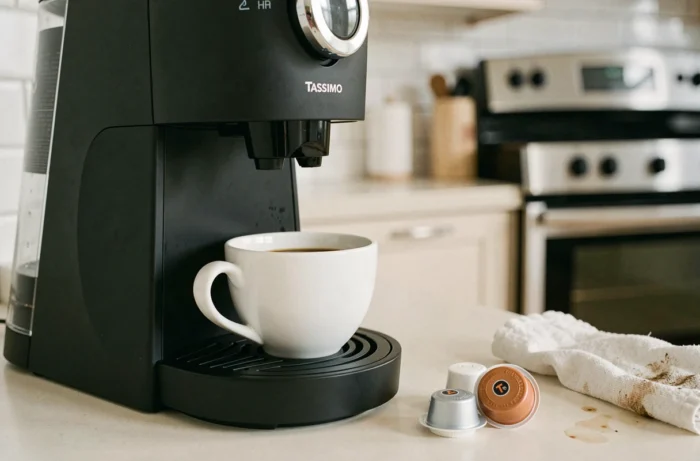
Your Tassimo fills the cup halfway, sometimes even less, while the machine seems to be functioning normally. The usual reflex is to start a descaling process. This is often helpful, but it is not always the right answer. The issue with small Tassimo coffees sometimes comes from a poorly read signal by the machine, a worn consumable, or an unnoticed usage gesture.
Tassimo machine signals: what the indicators reveal before a short coffee
Before disassembling anything, look at the indicator panel. Tassimo machines use lights to signal a specific problem. A steady or blinking red light does not mean the same thing as an illuminated descaling light.
The red light related to the water reservoir, for example, indicates that the float does not detect enough liquid. Even if the reservoir appears full, the float may be stuck due to limescale or simply mispositioned after a refill. The machine then reduces the amount of water sent, resulting in an abnormally short coffee.
Have you noticed that your Tassimo seems to “hesitate” at the start of the cycle? This behavior often indicates a T-Disc reading problem, not a pump issue. The machine reads a barcode printed on each capsule to determine the water volume and temperature. If this code is misread (capsule improperly inserted, dirty reader), the cycle starts with reduced parameters.
To delve deeper into the causes and solutions for small Tassimo coffees, it is essential to distinguish these machine signals from actual mechanical failures.

T-Disc and barcode: consumables that skew the dosage
T-Disc capsules are not just simple containers of ground coffee. Each one carries a unique barcode that dictates three parameters to the machine: water volume, temperature, and brewing time. This system is why a cappuccino capsule produces more liquid than an espresso.
When the barcode causes problems
A stained, scratched, or wet barcode is enough to disrupt the reading. The machine then applies a default cycle, often shorter than expected. This is neither a bug nor a malfunction, just miscommunication between the capsule and the machine.
Also, ensure you are using T-Discs compatible with your model. Capsules from other systems (even if they physically fit into the capsule holder) do not carry the correct code. The machine misinterprets them and reduces the volume.
The service disc, a forgotten consumable
The yellow service disc that comes with the machine is used for cleaning and descaling. Over time, its barcode wears out. A worn service disc prevents the cleaning cycle from functioning correctly, leaving residues in the water circuit and gradually reducing the flow.
If your machine is several years old, replacing this disc is inexpensive and sometimes resolves the issue without further intervention.
Tassimo water circuit: beyond limescale
Descaling remains a useful step when the “calc” light comes on. Limescale reduces the internal diameter of the conduits and slows down the pump. Up to this point, traditional tutorials are correct. What they rarely mention is that the water circuit can be obstructed by something other than limescale.
- Dried milk residues (after cappuccinos or hot chocolates) accumulate in the capsule holder and in the outlet nozzle, reducing flow even on a recently descaled machine.
- The internal filter of the reservoir, when it exists, clogs with impurities from tap water. A simple rinse under running water is often enough to restore flow.
- The pump itself may lose power after several years of use. If the sound of the pump has changed (quieter or higher-pitched), the extraction pressure is insufficient for a full coffee.
Regular descaling remains useful, but it does not fix a milk residue stuck in the nozzle or a tired pump.

Usage gestures that reduce volume without us knowing
Some daily habits produce short coffees without any indicator lighting up. They go under the radar because they do not trigger an alert.
The reservoir filled halfway
The Tassimo sometimes adjusts its cycle based on the water level detected by the float. If the reservoir is only half full, the machine may limit the volume to avoid running empty. Filling the reservoir above the minimum mark before each use eliminates this factor.
Chaining cups too quickly
Starting a second coffee immediately after the first does not give the heating element time to heat the water to the correct temperature. The machine compensates by sending less water to maintain the target temperature. A delay of a few tens of seconds between two preparations is enough to restore normal volume.
The capsule holder not locked properly
If the lid of the capsule holder does not close completely, the piercing pressure of the T-Disc is insufficient. Water then partially bypasses the capsule, and part of the volume ends up in the drip tray instead of the cup. Check that the closing mechanism clicks firmly.
Tassimo preventive maintenance: avoiding the return of short coffees
The most effective approach is not to wait for the coffee to become too short to take action. A simple routine covers most causes:
- Rinse the reservoir and capsule holder with clear water after each session of milk-based drinks.
- Run a cleaning cycle with the service disc at least once a week, without a coffee capsule.
- Descale the machine as soon as the “calc” light comes on, without postponing the operation for several weeks.
- Check the float of the reservoir by removing it and then replacing it to ensure it slides freely.
Regular maintenance prevents the majority of short coffees much more effectively than troubleshooting afterward. Recent Tassimo support content goes in this direction, structuring support around a logic of preventive maintenance rather than one-off repairs.
Short coffee does not have a single cause. It is the combination of a misread barcode, a partially obstructed water circuit, and small usage reflexes that produces the disappointing result in the cup. Identifying the right signal, in the right place, remains the quickest way to get back to a properly sized coffee.