Finding an on-call doctor near you requires knowing which channel to use, at what time, and for what type of care. The options vary depending on the area, time slot, and nature of the medical need. This article compares the main systems available in France, their operating hours, and their reimbursement conditions.
Comparison of Channels to Reach an On-Call Doctor in France
Several systems coexist, each with distinct operating hours and contact methods. The table below summarizes the main differences.
| Channel | Availability | Contact Method | Type of Consultation |
|---|---|---|---|
| 15 (SAMU/SAS) | 24/7 | Phone call | Regulation, direction to on-call or emergency services |
| SOS Médecins | 24/7 in covered areas | Call or book an appointment online | Home visit or consultation at the center |
| On-call medical center | Evenings, weekends, holidays (variable by ARS) | After regulation by 15 or local number | On-site consultation |
| Teleconsultation | Variable by platform | App or website | Video transmission |
The first reflex remains to call 15. This number is not limited to life-threatening emergencies: the Service d’Accès aux Soins (SAS) also directs to unplanned care consultations, including outside of serious situations.

For patients looking to identify the right contact based on their location, it is possible to consult the Medicaloc website to find available medical resources in their geographical area.
Continuity of Care: Hours Vary by Region
The continuity of outpatient care (PDSA) does not follow a single national schedule. The ARS of each region defines the applicable on-call hours locally.
The general framework covers nights from 8 PM to 8 AM, Saturday afternoons, Sundays, and holidays. In practice, some rural areas restrict on-call services to nights only, due to a lack of volunteer doctors. Other regions, better equipped, maintain extended coverage on Saturday mornings.
This disparity has a direct consequence: a patient calling 15 on a Saturday at 2 PM may be directed to an on-call medical center in a metropolitan area, but redirected to hospital emergency services in an under-resourced department. Calling 15 remains the only reliable way to know the active on-call services at any given moment in a specific area.
SOS Médecins: Unequal Coverage Across the Territory
SOS Médecins offers home visits and consultations at centers in several dozen French cities. The network operates continuously in the major covered urban areas.
However, many medium-sized towns and rural areas have no branches. Before relying on this service, checking its local availability can save valuable time in urgent medical situations.
On-Call Teleconsultation: Reimbursement Conditions and Regulatory Limits
Teleconsultation appears as a quick alternative to obtain medical advice outside of office hours. However, its reimbursable access conditions are governed by specific rules.
- The consultation must be conducted via video transmission, not just through a phone call or messaging.
- It must be part of the coordinated care pathway, ideally with the treating physician or a doctor referred by them.
- An alternation with in-person consultations is required to maintain a care relationship in line with the conventional framework.
These conditions mean that an isolated teleconsultation, conducted on a platform without a link to the treating physician, may not be reimbursed at the usual rate.
Paid Fast-Track: A Prohibited Practice for Reimbursable Access
Some teleconsultation platforms offer priority access for an additional fee. The decree of February 29, 2024, allows optional paid services in certain cases. However, Health Insurance has reminded that a price increase conditioning access to teleconsultation is prohibited when it takes the form of a fast-track service.
This distinction has become a subject of public controversy. Patients who pay extra for faster teleconsultation do not necessarily benefit from a better care pathway. They simply access a quicker slot, without any additional guarantee on the quality of care.
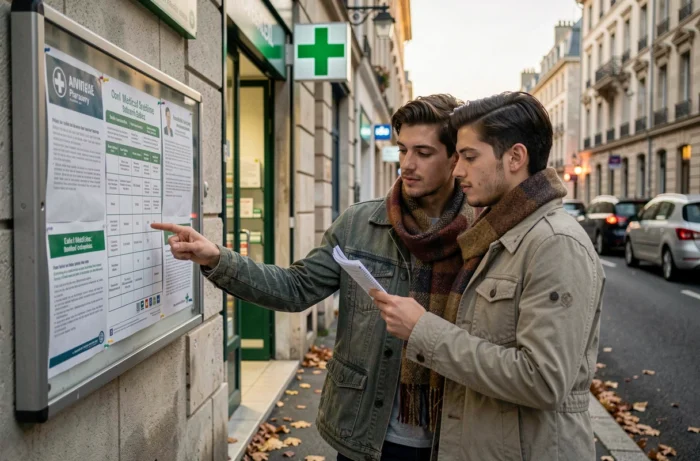
On-Call Doctor: Which Path to Follow Depending on the Situation
The choice of the right channel depends on two criteria: the perceived severity of the situation and the ability to travel.
- Acute but non-life-threatening symptom (persistent high fever, intense pain, urinary infection): call 15 to be directed to the on-call doctor in the area or an on-call medical center.
- Inability to travel with a real medical need: request a home visit via SOS Médecins if the service exists locally, or through the regulation of 15.
- Need for a prescription renewal or medical advice without a physical examination necessary: teleconsultation may suffice, provided the care pathway rules are followed.
- Life-threatening emergency (chest pain, severe breathing difficulty, loss of consciousness): call 15 immediately, not an independent on-call doctor.
The telephone regulation by 15 is specifically designed to sort these situations. It prevents both the overcrowding of hospital emergency services and the inappropriate use of an on-call doctor for a problem that could wait until the next day.
The landscape of continuity of care remains fragmented between local numbers, digital platforms, and hospital systems. The 15, as a regulated single entry point, remains the most reliable channel for obtaining appropriate guidance, regardless of the territory or time.