The environmental regulation RE2020, applied to individual houses since 2022, has redefined what it means to build an eco-friendly house in France. The framework is no longer limited to the energy performance of the building in operation: it now integrates carbon emissions over the entire life cycle, from the manufacturing of materials to their end of life. This approach concretely modifies the technical and financial trade-offs of a sustainable construction project.
Carbon footprint of a new construction: the criterion that RE2020 has changed
Before RE2020, the evaluation of a house focused on its energy consumption once inhabited. Heating, hot water, ventilation: these elements determined the building’s rating. The calculation largely ignored what happened upstream and downstream.
RE2020 introduced a life cycle analysis. A highly efficient piece of equipment in use, such as certain high-end heat pumps, does not guarantee a favorable environmental balance if its manufacturing or replacement is highly polluting. This shift in perspective requires examining each component of the project from a different angle.
In practice, the choice between wood wool insulation and synthetic insulation is no longer solely based on thermal resistance. The carbon footprint of production, transportation, and recycling enters the equation. Specialized resources compile this data to help future homeowners compare supply chains, such as the page https://www.maisons-eco-durables.fr/ which lists sustainable construction approaches.
The Ministry of City and Housing has made public the data from the RE2020 Observatory regarding completed individual houses. This transparency allows for comparing the actual reported performances, rather than just the promises made by builders. For an individual developing their project, consulting this data provides a more reliable starting point than commercial brochures.
Biosourced materials and reuse: where the field stands
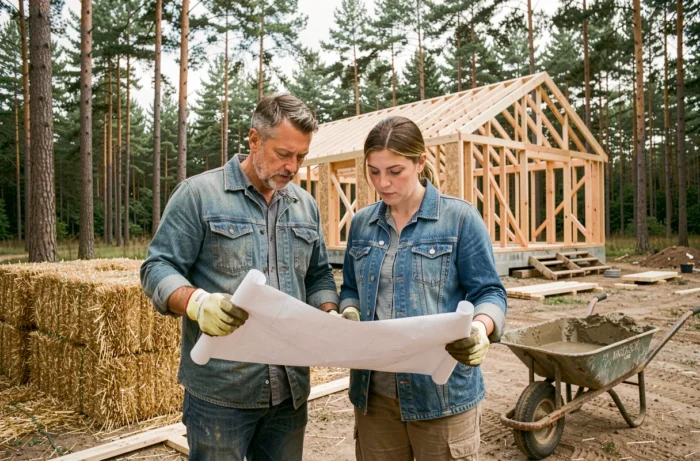
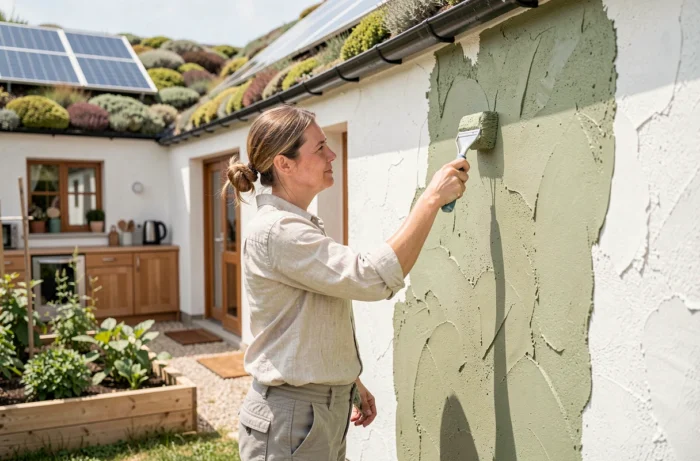
Wood, straw, hemp, or cellulose wadding are among the most commonly used biosourced materials in eco-friendly construction. Their main advantage lies in their ability to store carbon throughout the building’s lifespan, which mechanically lightens the environmental balance required by RE2020.
Wood remains the most documented material. Its thermal insulation capacity, mechanical strength, and renewable nature make it a coherent choice for a frame or cladding. Field feedback varies on this point: depending on the species, treatments, and implementation conditions, actual performances can vary significantly from one site to another.
Reuse moves beyond principle discourse
Large-scale operations are beginning to integrate the reuse of materials at the level of entire programs. Even though these projects mainly concern collective or social housing, they demonstrate that reuse can be organized industrially, not just artisanally.
For an individual house, reuse remains more complex to implement. Finding homogeneous lots of bricks, frameworks, or joinery requires time and a network of local suppliers. The potential savings on material costs can offset this organizational overhead, but the available data does not yet allow for precise quantification of this balance at the scale of a house.
Bioclimatic design: choices that impact energy bills
The orientation of the building, the arrangement of openings, and the compactness of the heated volume are free parameters at the design stage. However, they determine a significant portion of energy consumption over the entire lifespan of the house.
A compact south-oriented house reduces heating needs without resorting to additional equipment. South-facing glazing captures heat in winter, while solar protection (eaves, sunshades) limits summer overheating. In contrast, west-facing glazing, often responsible for overheating at the end of the day, should be reduced or protected.
Insulation plays a complementary role. For an eco-friendly house, three areas deserve particular attention:
- The roof, which represents the primary source of thermal loss in an individual house, requires a thicker layer of insulation than the walls
- The exterior walls, where external insulation eliminates most thermal bridges related to the structure
- The ground floor, often neglected, which generates a disproportionate feeling of discomfort compared to the surface area of loss
Controlled mechanical ventilation with double flow recovers heat from the extracted air to preheat the incoming air. This system reduces losses related to air renewal, but its installation and maintenance costs (filters, ducts) must be integrated into the overall budget.
Budget for an eco-friendly house: initial extra cost and return on investment
Building an eco-friendly house costs more than conventional construction. The extra cost comes from materials (wood, biosourced insulation), equipment (heat pump, solar panels, double flow MVHR), and sometimes the complexity of implementation for craftsmen who are not well trained in these techniques.
Long-term energy savings offset part of this investment. A passive or positive energy house can reduce heating bills to a marginal level. The return on investment depends on energy prices, climate zone, and the level of performance aimed for.
Several points should be negotiated from the design phase:
- Prioritize the envelope (insulation, airtightness) before investing in expensive active equipment, as a well-insulated building reduces the sizing of all heating systems
- Compare the overall cost over the lifespan, not just the price per square meter at delivery
- Check eligibility for local and national financial aid, which varies by region and performance levels achieved
RE2020 will extend from May 1, 2026, to new categories of buildings (hotels, shops, nurseries, healthcare facilities). For hybrid projects that include a professional component, regulatory requirements may differ from those applicable to individual houses alone. This regulatory point should be verified with a thermal study office before submitting the building permit.
Public access to performance data of new houses via the RE2020 Observatory is gradually changing the power dynamics between builders and individuals. Comparing what a builder promises to what their previous achievements have actually reached becomes possible. For an eco-friendly house project, this verification likely represents the best investment of time before signing a contract.