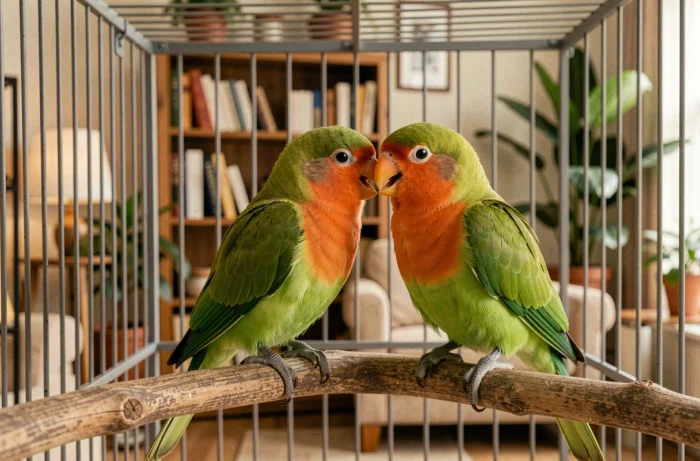
Your lovebird starts vocalizing as soon as you leave the room, or lets out a series of high-pitched cries at sunrise. These vocal behaviors are neither random nor capricious. In social psittacines like lovebirds, each vocalization serves a specific function related to communication, emotional state, or living conditions in the cage.
Contact calls and distress cries: two vocalizations not to confuse
Lovebirds are social birds. In the wild, they maintain connections with their peers through contact calls, brief and regular cries that mean “I’m here, where are you?”. In captivity, this mechanism persists. When you move out of your bird’s line of sight, it emits a contact call directed at you, its main social companion.
This cry becomes problematic when it turns into a loop. A lovebird left alone for long hours develops repetitive cries that are no longer simple calls but indicate a real deficit in social stimulation. A recent guide on pet lovebirds confirms that boredom and prolonged isolation lead to distress vocalizations, feather plucking, and hyper-attachment to the owner.
To better understand the causes of lovebird singing, it is essential to distinguish normal contact calls (brief, spaced, which cease when you respond) from distress cries (continuous, high-pitched, which intensify over time).
Stress and cage environment: often ignored triggers
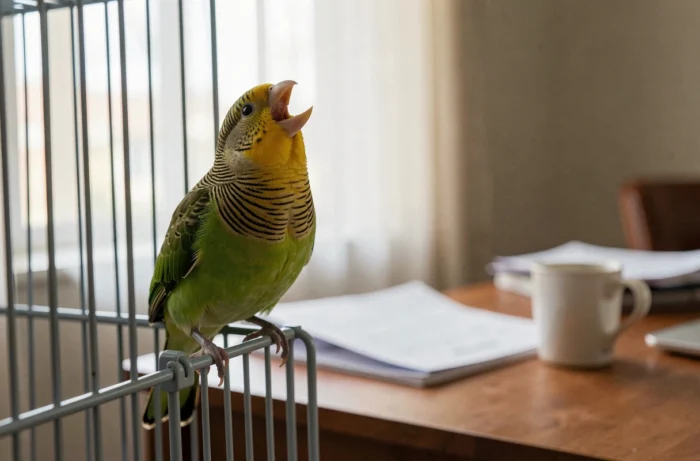
Have you ever noticed that your lovebird cries more on certain days? The immediate environment of the cage plays a direct role in the volume and frequency of vocalizations.
An unsuitable housing generates excessive vocalizations. A cage that is too small, placed in a high-traffic hallway, or exposed to drafts causes a state of chronic stress. The bird lacks a safe space to retreat, and its cries reflect constant frustration.
Several environmental factors exacerbate vocalizations:
- A lack of toys and branches to chew on, depriving the bird of mental stimulation and leading it to vocalize to alleviate boredom
- Sudden changes in the room (moving the cage, the arrival of a new pet, renovations), triggering alert cries related to insecurity
- A disrupted light cycle, for example, a room lit late at night, preventing the bird from resting and increasing its vocal irritability
- The absence of bathing or misting, a source of physical discomfort for a tropical bird accustomed to humidity
Excessive vocalizations are now considered by avian behavior specialists as a sign of deficient well-being, rather than just a personality trait. Treating the cause rather than the symptom radically changes the approach: it is not about silencing the bird, but identifying what drives it to cry.
Natural vocalizations of lovebirds: what is normal on a daily basis
Not all cries signal a problem. Lovebirds naturally vocalize at specific times of the day, and trying to eliminate these sounds would be counterproductive.
The morning and evening vocal peak is a natural behavior. At sunrise, the bird announces its presence and “greets” its group. At the end of the day, it vocalizes again before perching for the night. These two periods usually last a few minutes and should not be a cause for concern.
A healthy lovebird also emits soft chirps when relaxed, little cries of pleasure during bathing, and contact sounds when it sees you preparing its food. These low-intensity vocalizations are a sign of a balanced bird.
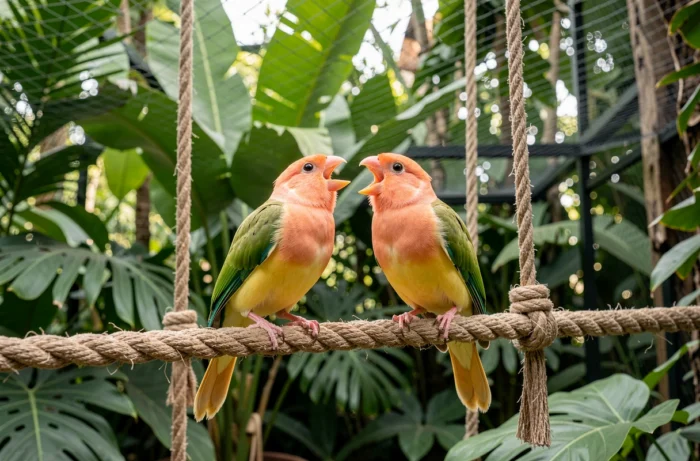
The line between normal vocalization and problematic cry lies in duration and intensity. A contact call lasting a few seconds is healthy. A continuous cry lasting several minutes, especially if accompanied by agitated behavior (wing flapping against the bars, ruffled feathers, refusal to eat), signals a discomfort that needs investigation.
Soothing excessive vocalizations: a cause-based approach
Punishing a lovebird for crying, covering its cage, or yelling back reinforces the behavior. The bird gets a reaction, whatever it is, and associates the cry with the attention received.
The effective approach is to address each identified cause:
- Against loneliness: spend time in the same room, talk regularly to the bird, and consider getting a companion if absences are long. A second lovebird significantly reduces contact calls directed at humans
- Against boredom: offer rotating toys (change cage accessories weekly), fresh branches to strip, forage to search for in crumpled paper
- Against environmental stress: place the cage in a quiet corner with one side against the wall to create a safe zone, maintain a stable day-night cycle
Calmly responding to the contact call works better than completely ignoring it. A simple word spoken from the other room is often enough to reassure the bird and stop the vocal loop. The goal is not silence, but a level of vocalizations compatible with a serene bird.
Observing the signs associated with cries (feather posture, wing movement, feeding behavior) helps quickly identify whether a vocalization indicates a specific need or a deeper problem. A lovebird that vocalizes moderately is a bird that communicates, which remains the normal functioning of a social animal living by your side.