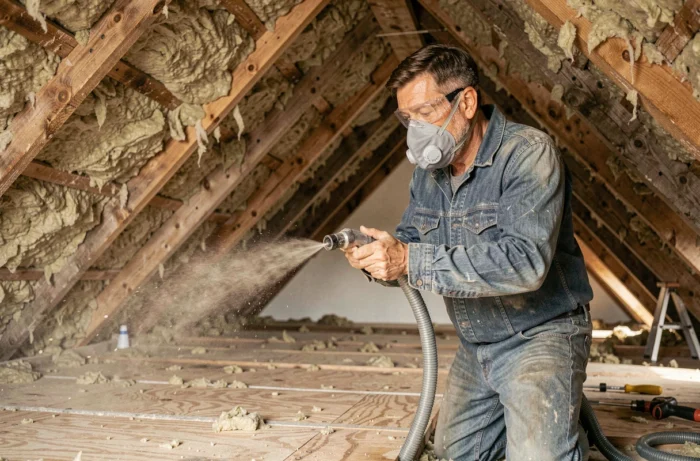
The cellulose wadding sold in DIY stores is not a generic product. According to the manufacturer, the fire retardant treatment, the residual dust content, and the nominal density vary enough to change the behavior of the material once blown into the attic.
Before loading a cart at Brico Dépôt, we recommend checking three items on the product sheet: the fire reaction classification B-s2,d0, the declared thermal conductivity, and the validity date of the report issued by an accredited laboratory.
Fire classification and report: what the product sheet must indicate
A compliant bag of cellulose wadding carries a fire reaction classification. The B-s2,d0 level, achievable through fire retardant salts added at the factory, places this bio-sourced material among the most effective in fire safety. This classification is not decorative: in collective housing or ERP, an insulator without a valid report is legally non-compliant.
The report is issued by an organization such as CSTB or LNE, and its validity lasts for five years. We observe that few individuals think to check this date before purchase. Archive the report with the invoice for the work: in case of a disaster, the insurer may request it.
To better understand how to use cellulose wadding from Brico Dépôt within a solid regulatory framework, always check that the report number is on the packaging or the technical sheet downloadable in-store.
Thickness of cellulose wadding and eligibility thresholds for aid
The installed thickness determines the thermal resistance, and this thermal resistance conditions access to financial support schemes. An R7 (about 34 cm of blown wadding) is the minimum to qualify for energy renovation aid. Aiming for an R8 or R9 allows reaching Low Energy Building levels, or even Passive Construction.
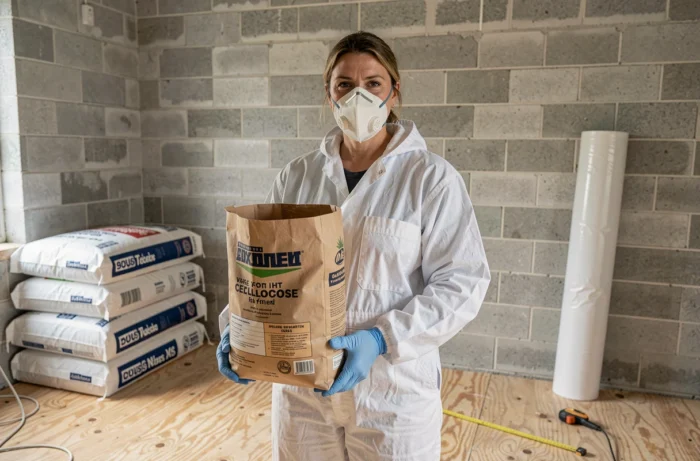
Cellulose wadding settles by about 20% over its lifespan. This settling is factored into the initial thickness calculations: the installed thickness must be increased by 20% compared to the target thickness. For an R7, this means blowing more than 40 cm initially. Positioning height markers in the attic, spaced regularly, remains the most reliable method to ensure a uniform layer.
If you do not increase the thickness, the thermal performance will degrade below the required threshold within a few years, which may lead to non-compliance with commitments made under MaPrimeRénov’ or CEE.
Adjusting the blower and installation density
Mechanical blowing is the only truly effective technique for insulating lost attics with cellulose wadding. Manual spreading, sometimes presented as an economical alternative, produces an irregular and under-densified layer that compromises long-term performance.
The adjustment of the blower conditions the density of the material at the pipe outlet. A density that is too low promotes premature settling; a density that is too high clogs the hose and consumes more bags for the same area. We recommend conducting a test on one square meter before starting the blowing across the entire attic.
- Check the air flow and material flow on the blower before each job, even if the machine was used the day before.
- Keep the hose at a consistent distance from the floor to avoid localized excess thickness that hides under-insulated areas.
- Control the thickness obtained at several points using the pre-installed markers, not just at the center of the attic.
- Wear an FFP2 mask and protective goggles: cellulose fibers irritate the respiratory tract and mucous membranes.
Safety distances around heat sources
Smoke ducts impose a regulatory spacing defined by the Technical Prescription Document 3693. Any blown bulk insulation, including cellulose wadding, must respect this distance. A non-combustible covering (sheet metal or rigid panel classified A1) delineates the exclusion zone around the duct.
Recessed halogen spots represent another critical point. Each recessed light fixture must be protected by a fireproof cover before blowing. Recent LED spots emit less heat, but protection remains mandatory until the fixture is certified for direct contact with the insulation.
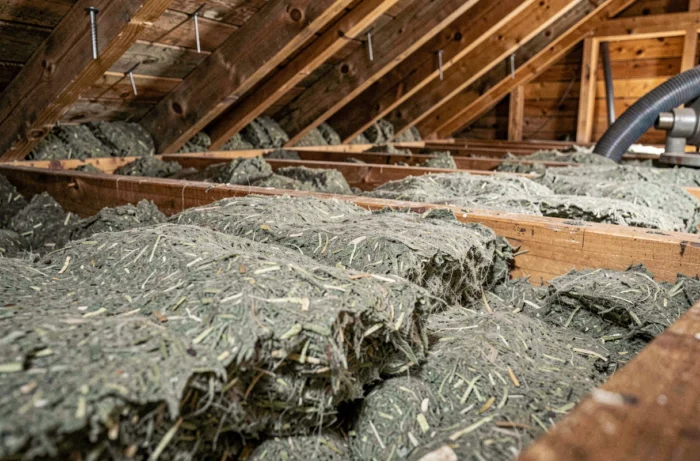
Choice of packaging and calculation of the number of bags
At Brico Dépôt, cellulose wadding is generally offered in standard volume bags. The calculation of the number of bags is based on three parameters: the area to be covered, the increased thickness (including the 20% settling), and the target blowing density indicated by the manufacturer.
Underestimating the number of bags forces a halt in the work, creating a junction area between two blowing sessions. This junction constitutes a linear thermal bridge if not carefully addressed. Plan for a margin of a few extra bags rather than working to the exact number.
- Measure the actual area of the attic, deducting non-insulatable areas (hatches, ducts, inaccessible zones).
- Apply the blowing density recommended by the manufacturer, not a generic value found online.
- Add a safety margin of about 10% to the result obtained to account for floor irregularities and material losses in the hose.
Access hatch to the attic and air tightness
The access hatch is often the weak link in blown insulation. An uninsulated and non-sealed hatch significantly reduces overall performance, even if the rest of the area is perfectly covered. We recommend attaching a rigid insulation panel (wood fiber, for example) to the attic side of the hatch and installing a compressible perimeter seal to limit air leaks.
A poorly treated hatch can represent a disproportionate thermal loss compared to its surface area. This is a detail of implementation that distinguishes a well-executed job from approximate insulation. Before closing the attic, check that the hatch closes properly against its seal and that the added insulation does not hinder the operation.