
Are you preparing for a road trip in the United States where all distances are displayed in miles? Or are you following a running training plan written by an American coach? In both cases, converting miles to kilometers quickly becomes a necessity. The exact coefficient is easy to remember, but there are a few common pitfalls worth discussing to avoid sometimes significant calculation errors.
The “times 2” factor trap and why it skews your distances
Before discussing the correct method, we need to dismiss a simplification that circulates widely. Some travelers round by multiplying miles by 2 to get kilometers. It’s quick, but it’s wrong.
According to a fact-checking article published by UnitFig in August 2026, using the factor of 2 overestimates the distance by about 24%. On a journey of a few miles, the discrepancy remains trivial. On a route of several hundred miles, you could end up with a distorted estimate of tens of kilometers, which skews driving time and fuel consumption.
This shortcut likely comes from the fact that 1 mile “is roughly” between 1 and 2 kilometers. The brain chooses the round number. A practical guide on Ei Mag details the reliable method and online tools that avoid this type of approximation.

Mile to kilometer conversion formula: the exact coefficient
One mile is exactly equal to 1.609344 kilometers. This is the official value. To convert, you multiply the number of miles by this coefficient.
In practice, remembering 1.609 is more than sufficient. For quick mental calculations, multiplying by 1.6 gives a very close result with a margin of error of less than one percent.
Concrete example with mental calculation
You see a sign indicating 50 miles to your destination. Here’s the reasoning:
- 50 x 1.6 = 80 kilometers (quick method, negligible margin of error)
- 50 x 1.609344 = 80.4672 kilometers (exact value, useful for software or spreadsheets)
- The difference between the two results represents less than 500 meters, which has no impact on planning a road trip
For short distances (less than 10 miles), mental calculation with 1.6 works without issue. Beyond 100 miles, using an online converter remains more comfortable.
Converting miles per hour to kilometers per hour
The conversion isn’t just about distances. In the United States and the United Kingdom, speed limits are displayed in mph (miles per hour). The same coefficient applies.
A speed limit of 65 mph corresponds to about 104.6 km/h. Again, multiplying mph by 1.6 gives a reliable estimate to know if you are driving within the limits compared to your usual benchmarks.
Why it’s useful beyond travel
Are you buying a vehicle imported from the United States or the United Kingdom? The speedometer displays mph. Some models offer a switch to the metric system in the settings, but not all. Knowing the factor of 1.6 allows you to read a speedometer in mph without hesitation.
Runners following Anglo-Saxon training plans encounter the same need. A pace of “8 minutes per mile” corresponds to a pace of about 5 minutes per kilometer. This conversion is valuable for calibrating sessions on a GPS watch set to kilometers.
Online conversion tools and apps in 2026
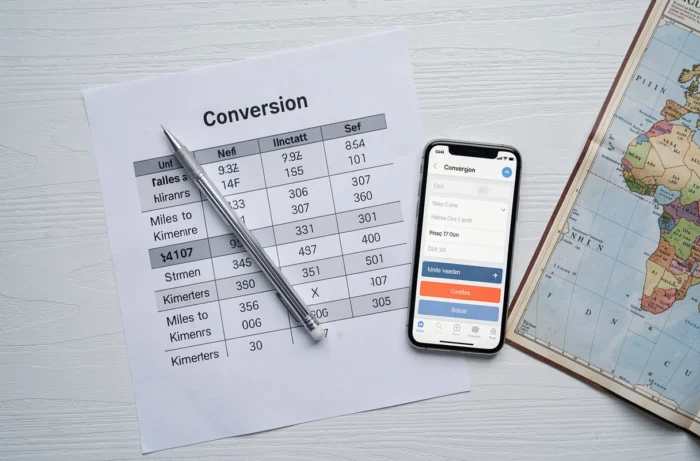
Mental calculation has its limits, especially when you need to convert several values quickly. Digital tools have evolved significantly in recent years.
Online converters remain the most direct solution. You enter a value in miles, and the result in kilometers is displayed instantly. Most search engines even integrate a mini-converter directly into the results: type “25 miles to km” in the search bar, and the answer appears without clicking on a site.
Dedicated mobile applications
On the app side, “all-in-one” converters manage distances, speeds, temperatures, and sometimes currencies in a single interface. In 2026, several of these applications have improved their accessibility, notably compatibility with screen readers like VoiceOver, making them usable by a wider audience.
Some also offer an automatic switch between data sources if the first one is unavailable. This mechanism, documented by AppTracker.ai for the Converter AM app updated in July 2026, ensures that the tool works even in case of server issues.
- Converters integrated into search engines are suitable for one-off conversions
- Dedicated apps are more convenient for repeated conversions (travel, sports training)
- Check that the app uses the coefficient 1.609344 and not a gross approximation
- For a spreadsheet, the formula remains the most reliable: cell in miles x 1.609344
Metric system and imperial system: understanding coexistence
The mile is part of the imperial system, inherited from the British Empire. The kilometer belongs to the metric system, adopted by the vast majority of countries. The United States, the United Kingdom (partially), and a few other territories continue to use the mile as a unit of road distance.
This coexistence is not going away anytime soon. British road signs still display miles. GPS applications sold internationally systematically offer the choice between the two units. Mastering the mile-kilometer conversion remains a lasting practical skill.
The coefficient of 1.6 for quick calculations, 1.609344 for an exact value, and an online converter for series of conversions: these three benchmarks cover all common situations, from road trips to sports training to reading an imported speedometer.