You just returned from vacation with several hundred photos on your phone. Three months later, you would struggle to recount half of the scenes captured. This gap between the number of images and the quality of the memory is not trivial: family photography can both nourish and impoverish memory, depending on how it is approached.
Photography and Memory: Why Taking Photos Can Make You Forget
Recent work in memory psychology has identified a phenomenon called the photo-taking impairment effect. The principle is simple: when we photograph a moment instead of fully experiencing it, the brain delegates storage to the device. Attention shifts to framing, the right angle, the frozen smile, and the sensory experience takes a back seat.
A study by Sophia Fabrizio, published in Memory & Cognition in 2025, confirmed this mechanism. The mere act of raising your phone to capture a scene reduces the ability to remember it later.
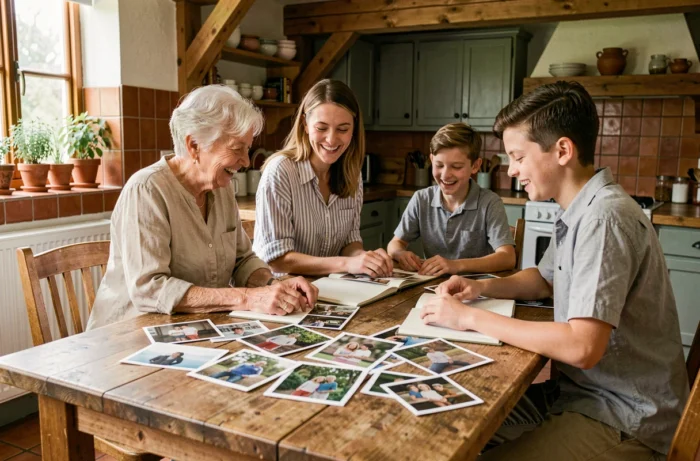
The good news is that actively reviewing your photos restores and strengthens the memory. Telling what happened, describing the details of an image, naming the people present: these actions transform the photo into a cue for memory. Without this step, the images remain an inert digital stock.
Practically, this means that the most useful moment is not when you press the shutter, but when you sit down with family to go through the photos together. This is indeed an approach found on joliefamily.fr, where family photography is conceived as a medium for sharing rather than mere accumulation.
Reducing the Volume of Photos to Create Real Family Memories
You may have noticed that your grandparents’ albums sometimes contained fewer than thirty photos per year, and each told a specific story? Rarity forced intention. Today, abundance produces the opposite effect.
Photographing less, but better, changes the quality of the memory. Instead of snapping away at a birthday snack, choosing three or four moments to capture forces you to observe more. You look at expressions, wait for the right moment, and participate in the scene before freezing it.
Three Guidelines for Intentional Photography
- Limit the photo session to about ten shots per family event, choosing moments that truly tell something (a fit of laughter, a tender gesture, an unusual detail)
- Put the camera down for at least half the time to experience the moment with your children, without a screen between you and them
- Sort through the photos the same evening: keep only the images that evoke an emotion or recall a specific detail, delete the rest
This immediate sorting is a form of active re-reading. It engages memory while the experience is still fresh, which strengthens the memory trace associated with the retained images.
Natural Light and Framing: Two Simple Levers for Successful Family Photos
No need for expensive equipment or photography training to obtain touching images. Two parameters make a difference in most family situations.
Light Changes Everything
Soft natural light, at the beginning or end of the day, softens features and adds depth to faces. Indoors, placing children near a window is enough to create flattering lighting. The phone’s flash, on the other hand, flattens faces and eliminates the shadows that give relief.
Get Down to the Subject’s Level
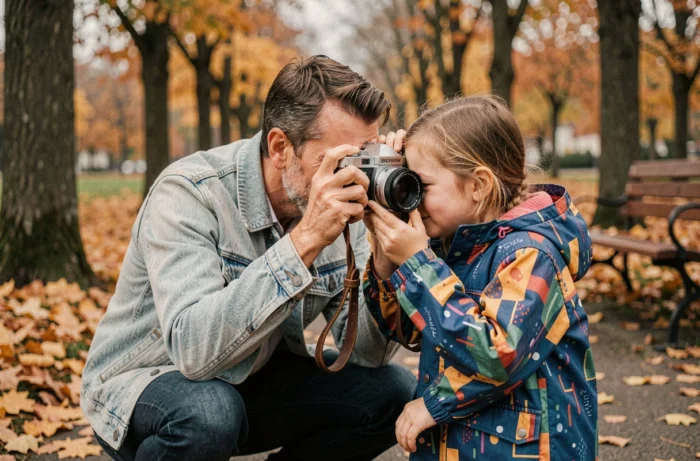
Photographing a child from an adult’s standing position produces an unnatural bird’s-eye view. Crouching to the child’s height transforms the perspective and captures their gaze on equal terms. This simple adjustment makes portraits more lively and intimate.
Another useful reflex: include a contextual element in the frame. A toy, a dish on the table, a landscape in the background. These details become much more powerful memory triggers than an isolated face against a neutral background.

Physical or Digital Photo Album: Which Medium to Transmit Memories
The majority of families now keep their images only on smartphones or in the cloud. The problem is twofold: these photos are rarely reviewed, and they disappear when an account is deactivated or a device is lost.
The physical album solves both problems. It can be flipped through, placed on a coffee table, passed down. A printed album naturally invites collective storytelling, whereas a digital folder remains silent.
- Choose quality photo paper that is dense enough for the pages to withstand repeated handling by children
- Add handwritten captions under the photos: the first name, the date, a word that summarizes the scene. These annotations become precious over the years
- Incorporate flat objects (entry tickets, drawings, little notes) to enrich the narrative beyond photography
- Create an album for each year or significant event rather than a single giant album that no one opens
The digital medium remains relevant as a backup. A shared folder in the family cloud allows centralization of the images each member has taken. The idea is to combine both: digital for storage, physical for reliving.
Family photography does not need to be perfect to fulfill its role. A slightly blurry image of a burst of laughter is worth more than a posed portrait where no one is really smiling. What matters is not the technical sharpness, but the photo’s ability to evoke a feeling, a voice, a shared moment.