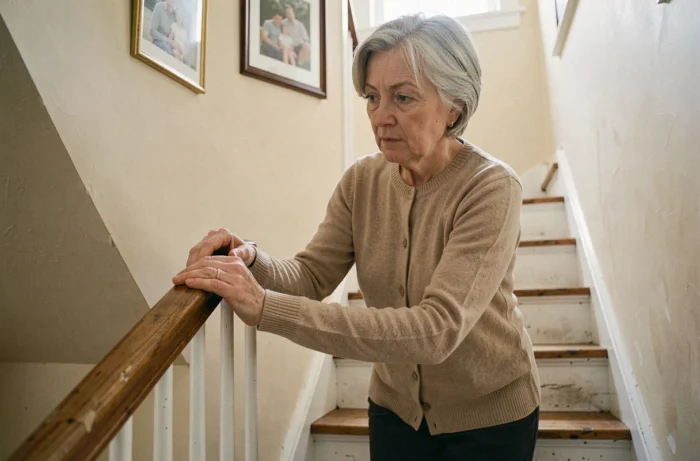
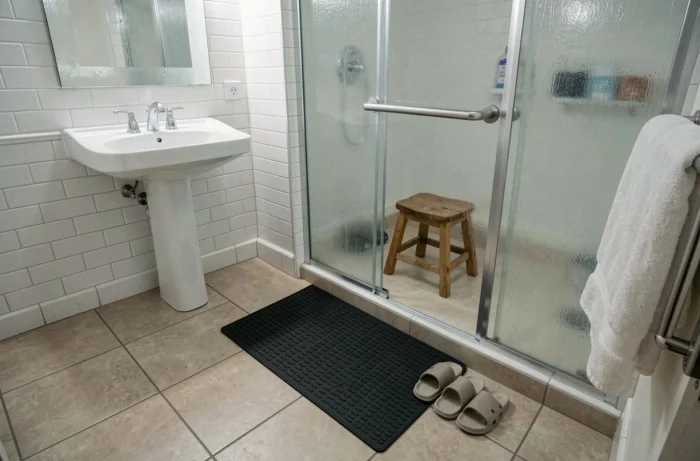
Every year in France, falls among seniors lead to tens of thousands of hospitalizations. This massive phenomenon calls for a precise analysis of the mechanisms at play. Understanding the factors that lead to these accidents allows for action on concrete levers, well beyond just a non-slip mat.
Insufficient human assistance: an underestimated risk factor for falls among seniors
In fall prevention, the focus is often on home modifications. Grab bars, level-access showers, and non-slip floors capture attention. However, the problem lies upstream: the actual access to human assistance for bathing, shopping, or outings.
A European study cited by the Institut Montaigne establishes a direct link between unmet assistance needs and an increased risk of falls among fragile seniors living at home. Unmet assistance needs increase the risk of falling.
Climbing onto a stool to reach an object up high, crossing a cluttered room, getting up from a low seat without support: these everyday actions become risky situations as muscle strength declines. A person who compensates alone for their mobility difficulties exposes themselves to dangers that regular assistance could easily mitigate. You will find information on portaildelasante.fr detailing this link between functional isolation and repeated falls.
Medications and balance disorders: interactions to reassess
Polypharmacy affects a significant proportion of elderly individuals. Among common treatments, some directly impact three parameters that condition walking stability: balance, alertness, and blood pressure.
Psychotropic medications (benzodiazepines, antidepressants, antipsychotics) are the best-documented classes. Their impact on reaction time and motor coordination can persist well beyond the night, especially when renal or hepatic function slows the elimination of the molecule.
Antihypertensives cause orthostatic hypotension: sudden drops in blood pressure upon standing. This mechanism destabilizes the person in the first seconds after getting up. It often occurs at night, during a trip to the bathroom in dim light, making it a particularly silent trap.
Reducing a dosage, spacing out a dose, substituting one molecule for a less sedative alternative: these targeted adjustments decrease the risk of falling without compromising the treatment of the underlying condition. Regular reassessment of the prescription by the attending physician is the most direct lever. An annual medication review remains a reasonable minimum.
Loss of muscle strength and sarcopenia: the spiral that accelerates falls
Sarcopenia is not just a loss of muscle volume. It reduces contraction power, reaction speed of postural muscles, and the ability to recover from a loss of balance. A senior whose quadriceps have lost a significant part of their strength will take longer to stabilize after a misstep.
This decline is self-perpetuating. After an initial fall, the fear of falling again leads to limiting movement. The resulting sedentary lifestyle accelerates muscle loss, degrades balance, and increases the likelihood of another accident.
Adapted physical activity: what works concretely
Programs combining balance training and lower limb strengthening yield the best results in prevention studies. One-legged support exercises, walking with changes in direction, stair climbing: these functional movements produce measurable adaptation.
- Static and dynamic balance exercises, at least twice a week, on varied surfaces (hard floor, carpet, outdoor terrain)
- Targeted muscle strengthening for the quadriceps, calves, and trunk muscles, with or without light weights
- Daily walking of at least twenty minutes, favoring routes with slight terrain variations
Supervision by a physiotherapist or an adapted physical activity instructor allows for adjusting the intensity to the person’s level of fragility. An overly ambitious program exposes individuals to injuries, while a program that is too light does not produce sufficient muscle adaptation.
Structured fall risk screening: towards a graduated pathway
Fall prevention tends to be organized according to the level of fragility. The Institut Montaigne describes a graduated pathway, from early detection to enhanced management, structured into several levels.
The first level relies on proximity screening, achievable in about half an hour. It includes simple functional tests (timed chair rise, one-legged support test, walking speed assessment) and identification of medication or environmental risk factors.
- Level 1: identification starting at age 50 by the attending physician or pharmacist, with targeted questions about fall history
- Level 2: comprehensive functional assessment for individuals who have fallen at least once in the past year
- Level 3: multidisciplinary specialized consultation (geriatrician, physiotherapist, occupational therapist) for recurrent fallers
- Level 4: enhanced support for loss of autonomy for the most fragile profiles
This model allows for concentrating resources on those who need them most, rather than disseminating the same advice to all audiences. Structured local screening is gradually replacing general awareness campaigns.
The challenge remains the transition between levels. A senior identified as at risk by their attending physician does not always easily access a multidisciplinary assessment, due to the availability of professionals or coordination among stakeholders. The available data do not yet allow for measuring the real impact of this graduated pathway on the national fall rate, but feedback from initial regional experiments is encouraging.