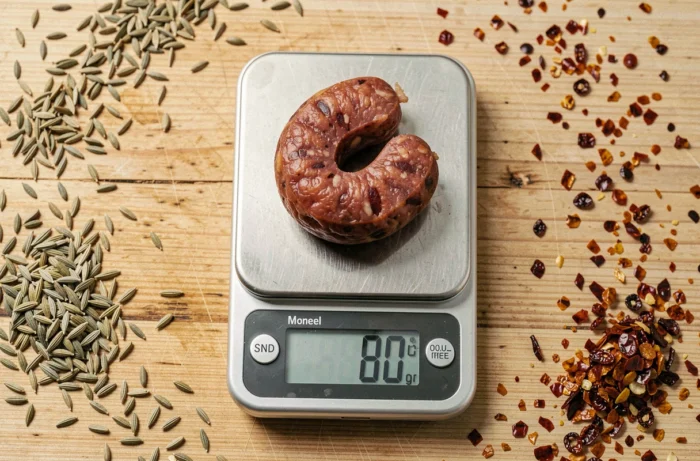
The weight of a merguez varies much more than one might think. Between a small supermarket merguez and an XL size from a butcher, the difference can range from simple to triple. Before planning the shopping for a barbecue, some numerical benchmarks help to buy the right amount, without surplus or shortage.
Weight of a merguez by format: comparison table
Online content often cites a range of 70 to 90 grams per merguez. This figure corresponds to the standard size, but it masks the real diversity of formats available on the shelf or at the butcher.
| Format | Indicative unit weight | Common packaging |
|---|---|---|
| Small (fine industrial type) | 50 g | Trays of 10 to 12 pieces |
| Standard (GMS or butcher) | 70 g | Trays of 6 to 12 pieces |
| Thick or artisanal | 90 g | Trays of 5 to 8 pieces |
| XL (specialized charcuterie) | about 200 g | Lots of 4 pieces for 800 g |
The XL format, packaged in 4 pieces for a net weight of 800 g, places the marker at about 200 g per merguez. This is more than double that of a classic thick merguez.
Before buying, simply divide the net weight indicated on the tray by the number of pieces. This simple calculation allows you to know the weight of a merguez without a scale, directly on the shelf.

Supermarket merguez or short supply chain: real weight differences
In large and medium-sized stores, the size tends to standardize around 70 g. Industrial production lines emboss the meat into casings of constant diameter, resulting in relatively homogeneous pieces from one tray to another.
In short supply chains, consistency decreases. Some farmers offer trays of 5 merguez for 330 g, or about 66 g per piece. At another artisan’s, the same tray of 5 pieces can reach 400 g.
This variability is explained by the natural casing, which does not have a perfectly uniform diameter, and by the manual stuffing that allows for more leeway than industrial machines. However, artisanal merguez often contain a different meat/fat ratio than GMS products, which also affects cooking behavior.
Why the diameter of the casing changes everything
The sheep casing, the most commonly used for merguez, has a variable natural diameter. A wider casing results in a thicker and therefore heavier merguez of equal length.
Collagen casings (artificial) offer a constant diameter. The choice of casing directly determines the final weight of each piece, with the same recipe.
Raw weight and cooked weight of a merguez: cooking loss
A standard 70 g merguez no longer weighs 70 g after being placed on the grill. Cooking causes a loss of water and fat that significantly reduces the final weight.
- The weight loss during cooking generally ranges from 20% to 30% of the initial weight, depending on the intensity of the fire and the duration
- A standard 70 g raw merguez therefore yields a cooked merguez weighing around 50 to 55 g
- XL merguez, being thicker, lose proportionally a little less because their center takes longer to heat up, which limits evaporation if cooking is controlled
The weight loss during cooking reaches 20 to 30% on a standard merguez. To estimate the amount of meat actually served, one must think in raw weight and subtract this percentage.
Impact on portion calculation
Counting 3 to 4 standard merguez per adult corresponds to about 210 to 280 g of raw meat. After cooking, this results in between 150 and 200 g of merguez on the plate. This benchmark remains valid for a barbecue with sides (bread, salads, sauces).
With XL merguez, two pieces per person are sufficient to reach a raw weight close to 400 g, which far exceeds the usual portion. Adjusting the number of pieces to the format avoids waste.
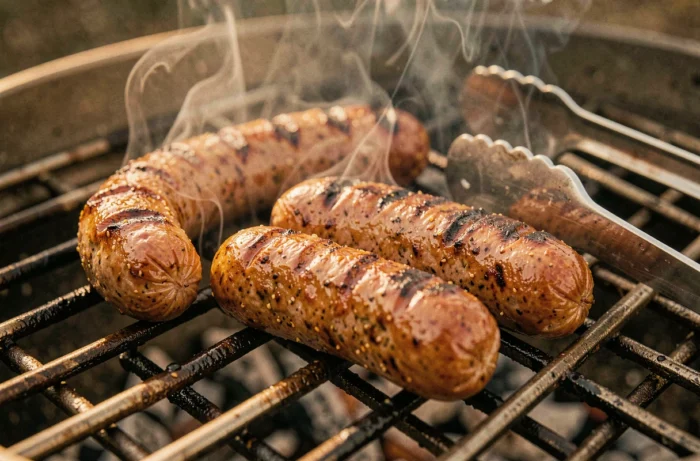
Beef-lamb merguez and composition: a weight factor often overlooked
The composition affects the density of the merguez and thus, at equal volume, its weight. A merguez containing a high proportion of fat will be slightly lighter than a very lean merguez of the same size, as fat is less dense than muscle.
Beef and lamb merguez remain the most common. Some recipes include only beef, while others mix lamb and beef. The lean meat/fat ratio modifies the density at equal volume, which explains why two merguez of different recipes do not show the same weight on the scale at the same diameter and length.
The spices (cumin, harissa, chili, coriander) represent a minimal fraction of the total weight. Their impact on the scale is negligible, but their salt content affects water retention during cooking.
Number of merguez per kilo: quick reference for shopping
The number of merguez in a kilo directly depends on the size:
- Small merguez of 50 g: about 20 pieces per kilo
- Standard merguez of 70 g: about 14 pieces per kilo
- Thick merguez of 90 g: about 11 pieces per kilo
- XL merguez of 200 g: about 5 pieces per kilo
For a barbecue for 10 adults with sides, counting 3 to 4 standard merguez per person, you should plan for between 30 and 40 pieces, or about 2 to 3 kg of raw merguez.
The most reliable reflex remains to read the net weight and the number of pieces on the packaging. When the information is missing (bulk at the butcher), asking for the size used is enough to estimate the portion per guest without surprises at serving time.